
"Ditmas Be the Place"
A spooky old mansion, a fantastical neighborhood, and the stirrings of what they call a beat

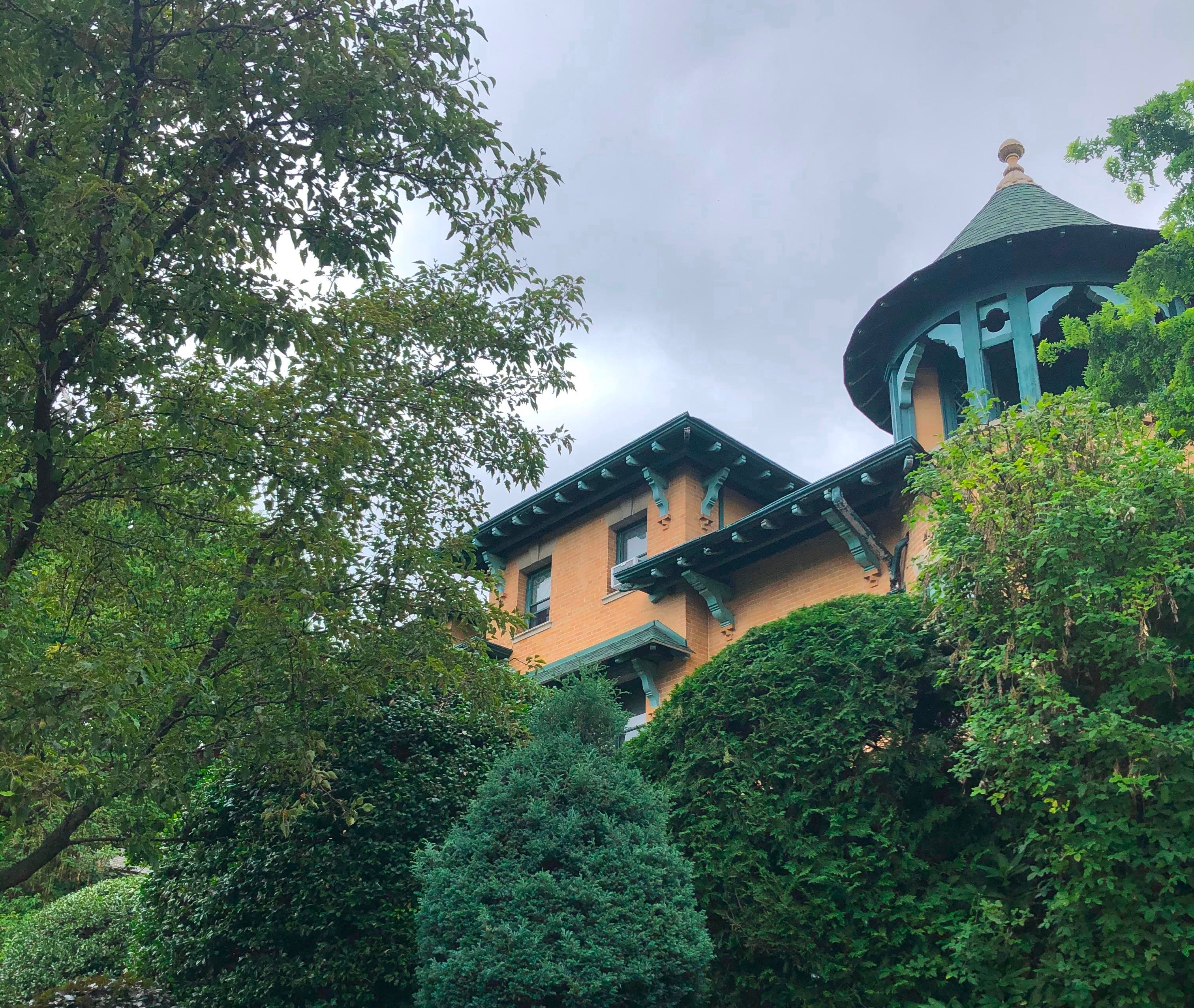
I recently published an essay in the New York Review of Architecture about a dilapidated old mansion and the suburban fantasy undergirding my former neighborhood in Brooklyn. Here’s how it starts:
A FEW DAYS BEFORE HALLOWEEN, a crumbling 5,870-square-foot single-family home was listed for $2.6 million in the Brooklyn neighborhood of Ditmas Park. Realtor photos lit creepily by flashlight showed a grand staircase with carved balusters falling out like teeth, a wood-paneled parlor flanked by an ornate fireplace, and a taxidermy Canada goose frozen midflight above a trove of antiques on the floor of a forgotten library. The New York Post called the six-bedroom, one-bathroom Colonial Revival, formerly owned by a Mr. and Mrs. George Van Ness, “one of Brooklyn’s few surviving Victorian-era homes” and lamented its “tragic” state of disrepair. A March New York Times feature cast the “once-majestic mansion” at 1000 Ocean Avenue as “a temple of profligate neglect” with a “murky” past and “even murkier” future. To the locals quoted in the article, the house’s deterioration was “an absolute tragedy”—and just plain spooky.
[…]
In all its haunted grandeur, the relic speaks to a particular fantasy that has defined this quarter of Brooklyn for more than a century. Locals tend to speak of the Van Ness mansion as a regrettable example of ill-preserved history, but its story is even more compelling for what it obscures. (Read more…)
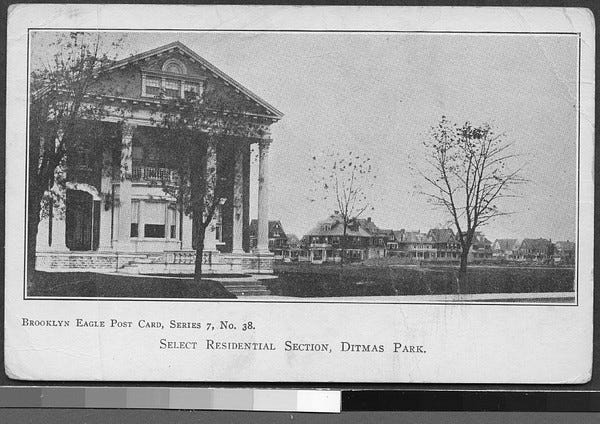
Here’s what the mansion looked like not long after it was built, when Ocean Ave. was still a dirt road:
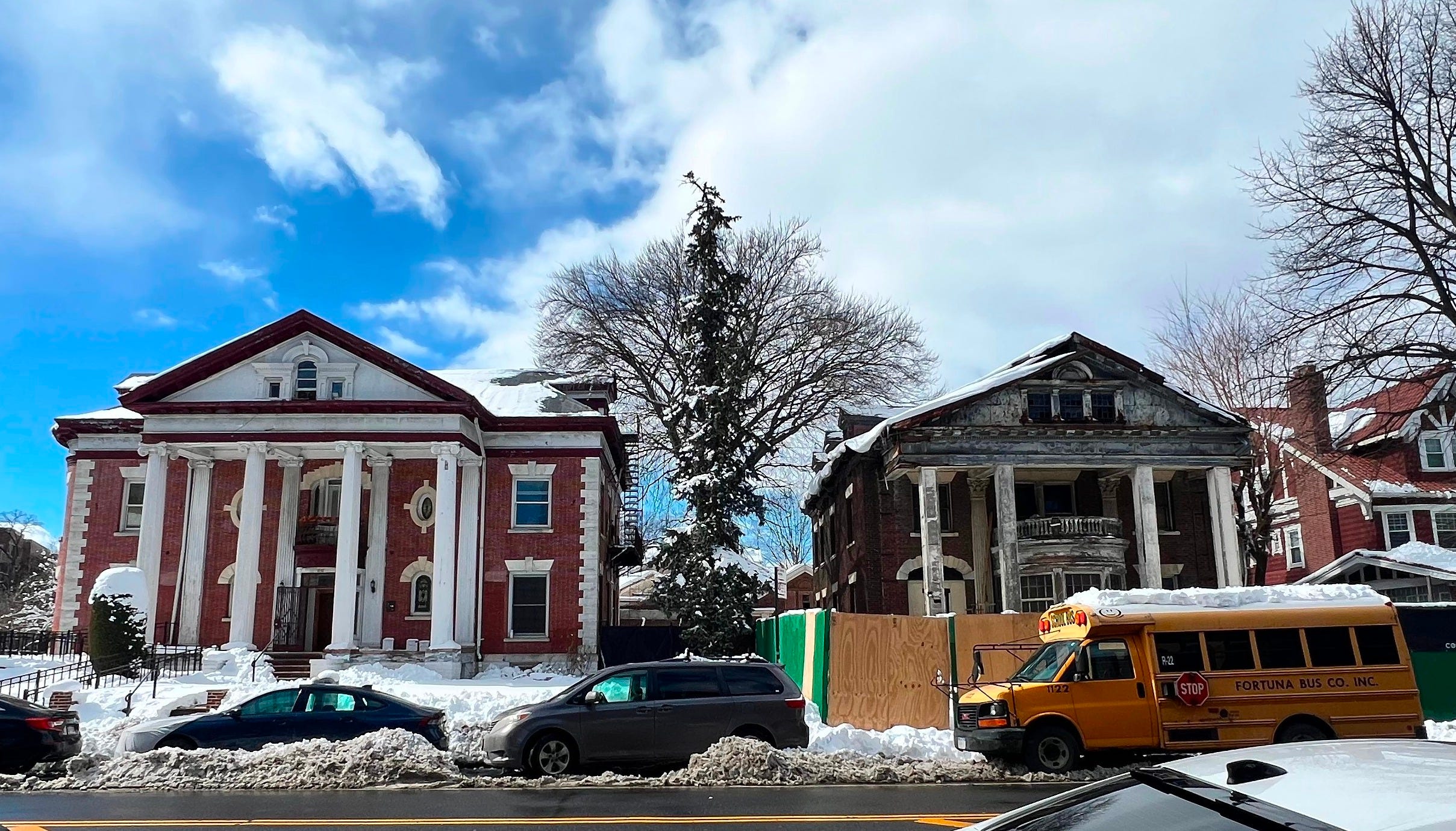
And here it is this winter, behind a construction fence and an ironically-labeled bus:
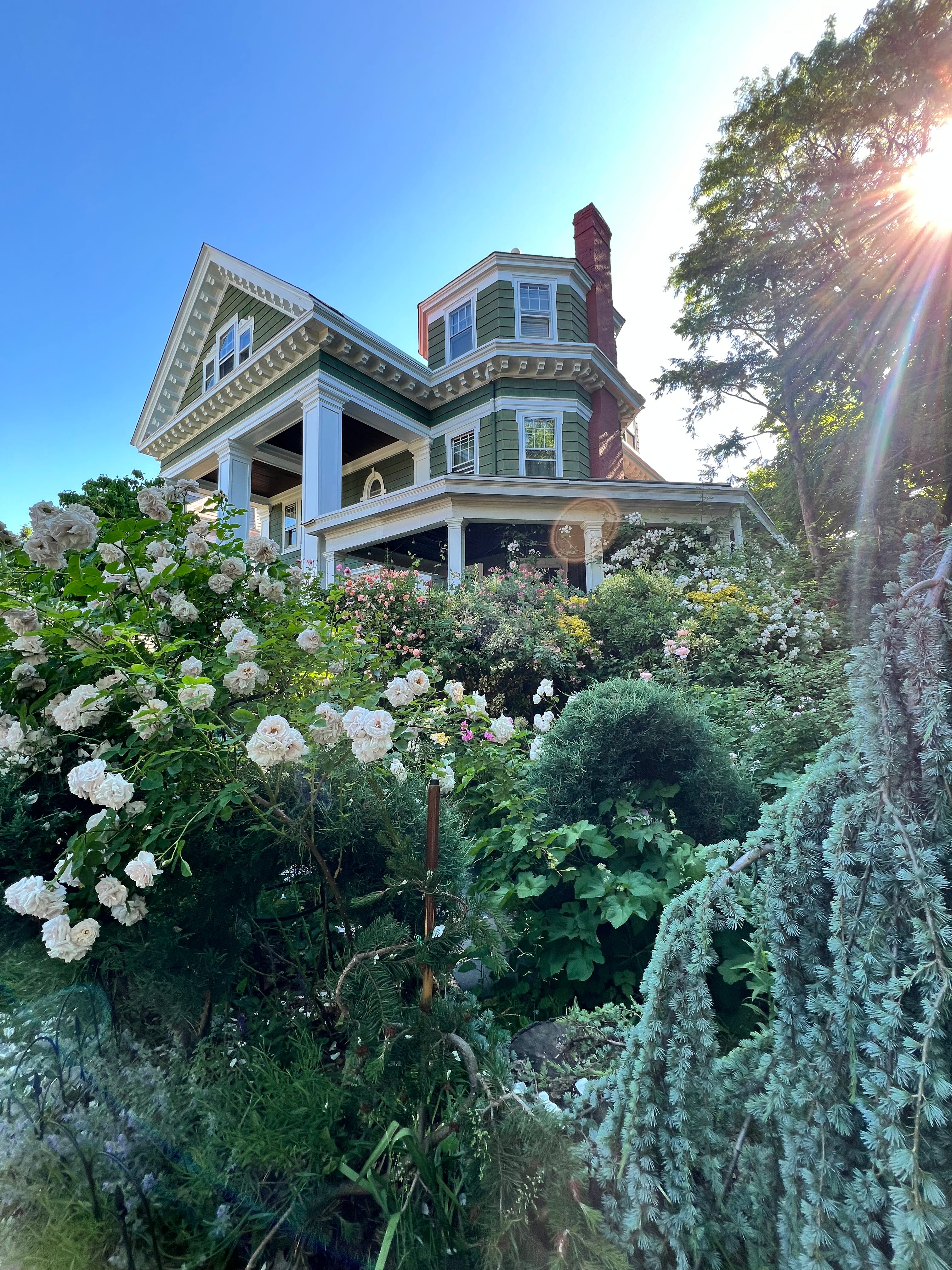
I fixated on the Van Ness mansion, but I’d been obsessed with the sociocultural history of Ditmas Park—known casually as “Ditmas,” by realtors as “Victorian Flatbush,” and by early twentieth-century guidebooks as “Brooklyn’s garden”—since moving there with my infant in 2020. The picturesque Victorians and verdant gardens enchanted me, and they still do, but of course the pseudosuburban charm hid more complicated histories. Ditmas has lived many lives—as Canarsee homeland, colonial Dutch farmland, Caribbean diaspora, and dreamscape for monied city dwellers longing for lawns and fences without giving up the MTA.
I’ve spent a weird amount of time pondering Nathaniel Hawthorne’s short story “Rappaccini’s Daughter,” in which a scientist raises his daughter in a poisonous garden. She becomes toxic herself, or you could say she develops immunity to the plants’ venom—not so her suitor, who learns the hard way that all the lush verdure hides a deadly truth. There’s something here about the fantasy of the secret garden and the question of who it leaves out, but for some unfathomable reason none of this Rappaccini stuff made it into the final essay. (Thank god for the editors we still have among us.)
I wouldn’t be as dramatic to say I uncovered a hidden poison in the process of reporting this piece, but I did learn all over again that urban landscapes are not neutral backdrops but places we collectively author, and these places can always tell stories other than the dominant ones we might have received. I became interested in what was unsaid or tamped down.
It was some luck that the New York Review of Architecture, a magazine I love, was also interested in the dilapidated grandeur of the Van Ness house, and in what it can tell us about the suburban fantasy of the neighborhood. Here’s a link to the NYRA piece, should you care to take a gander:
The reporting process for this story was tactile and interpersonal. I hope to do a lot more of it, at least if the industry holds. I realized that this neighborhood writing, like my tree writing, is ultimately about the ways humans encounter landscape, the ways we see ourselves in it or imagine ourselves separate from it. I keep thinking of the word “interface,” as in “human interface with landscape,” which is funny, since it’s also a term I associate with the false contact of the screen. Anyway, I think this is all coalescing into what journalists might call “a beat.” (!)
One more link to the NYRA piece: Ditmas Be the Place
Wish I could take credit for the Talking Heads reference in the title, but that was once again thanks to an editor.
You really captured the mix of beauty and classist exclusivity that gives the neighborhood it's strange character. Too often people leave that out.
One more detail that adds to the tragedy of the Ocean Ave mansion - the zoning, and that of Prospect Park South, is some of the most restrictive in the city. Even if someone came up with the money needed to make it habitable again, they could not make it into large luxury condos, but must keep it as an enormous single family house. The condo formula has managed to make other very expensive renovations of grand mansions pencil out in neighborhoods like Crown Heights, Clinton Hill, and Park Slope. But it is prohibited here.
I've been in Flatbush for 12 years, and was visiting Ditmas many years before that. I'm also fascinated by the many-layered history that you uncovered. Much of it I knew (mostly from Brooklyn Eagle archives) but you have details here that are new to me. Thank you for writing this.